Wednesday, September 15, 2010

A Glimpse of Hurricane Earl

As Hurricane Earl passed through, we decided to keep a journal of sorts, so that we would remember what the storm was like - and would be able to share it with you. Here is what we wrote at the time:

We finished getting the boat ready for the storm last night. Now it's the day of the storm, and Earl is coming ashore as a category 1 hurricane, somewhere around Lunenberg. Our apartment is sheltered - the building is an ell, and much of the time the wind and rain don't affect us. We're waiting for the storm.


8:30 am: Weather: the wind is gusting, it’s foggy out. The air is still warm and humid, after a hot week. It rained last night, and the advertising that always comes off the board over the pizza store started coming off. Now it’s peeling down at the corner, and by tonight it will be gone... Web cams seem a good way to see what's happening, but most of the web cams don’t seem to be working. Our view of the storm will be confined to what we can see from our windows.

Here's what we see. In the Narrows the white caps are just starting, and there is spray where they break on the shore on the Dartmouth side. Small birds have been flying around, sudden rushes of small winged creatures and some things - leaves, paper - are starting to blow around.


9:15 am: The rain is heavy, and blowing sideways. The Narrows are hard to see now, the tree branches are dancing around, the rain is blowing past in gusts. Our windows are still gapped to let fresh air in, very slightly, but not likely to remain so much longer. Ironically, there is more traffic on the road now than there was earlier. Wonder where they’re going, and why?

CBC is checking around the province - power out in various places - mixed weather all over the place, but wind picking up. Power just flicked off and on - if it happens again, time to turn the computers off.


9:45 am: The power flicked off and on again, so I closed down the computer for the duration of the storm. Better not to risk the possible consequences of a power surge.

The rain has eased for now. The wind is blowing the leaves off the trees behind the apartment building, and they are swirling over the roof and down in front of our window. We can see the gulls gathered on the ground by the cove down the street from us, where they are well-sheltered from the wind and waves. The wind is strong enough to make the sign for our apartment building pump in and out...


10:23 am: The wind is gusting hard, and the rain is blowing sideways, in curtains, in the gusts. We are under a hurricane watch, not a tropical storm watch, thanks to the change in Earl’s course which is bringing the storm much closer to us than forecast earlier. The storm is coming ashore close to Mahone Bay, instead of further west. There are reports from Peggy’s Cove that the waves are very heavy, and in spite of the efforts of the police some foolish people have found their way out on to the rocks.


11:11 am: The wind is picking up. The electrical wires running along the road are moving. There are lights flashing by the Narrows, down by the railroad tracks, but we can’t see what is there. The trees are bending, and the advertising boards we can see from our window are moving, waving back and forth around their axes. The board that always loses it’s ad is doing what it usually does - most of the ad that was there has been washed and blown away. Reports on CBC say that the waves along the coast are building; that some sailboats have moved their moorings and drifted, and one that was moored on the LaHave River has been seen moving out to sea.

We can’t see the Narrows any more, never mind seeing across them; what we can see is the wind gusts driving the rain. Small branches are blowing along the road now, and a few bags of garbage. Every now and then CBC fades and comes back; the power flickers occasionally, but it keeps coming back on.


Noon: The rain is blowing in visible gusts. The trees by the bottom parking lot, which until now were sheltered a little bit by the building, are dancing, showing the underside of their leaves and bending and nodding in the wind. The wind looks as if it is picking up spray off the waters in the Narrows, and in the cove where the gulls are sheltering; the bridge across the Narrows which we can usually see, is invisible for now. There are reports of lots of trees down throughout Halifax.


12:12 pm: The rain is streaming so hard down the windows that it’s hard to see through them. The forecasters say it will be another hour or two until the worst part of the storm passes. The wind is gusting over 90 km/h, Earl has lost a little bit of it’s ferocity since coming ashore. Leaves and small branches are flying, swirling in the air and on the ground. People are driving past - going some place they don’t need to go?


12:50 pm: The wind is gusting in excess of 100 km/h, but the sky is growing lighter and we can see the Narrows again. We can also see that the gulls are still firmly planted on the ground.


1:24 pm: The skies are continuing to grow lighter. The wind has come around and is out of the SW, and is blowing hard against our windows. There are reports of lots of boats dragging in the Bedford Basin, at the top of the harbour above the Narrows, in the mooring field around the Bedford Basin Yacht Club. The wet flags on the roof below our windows are blowing hard now, flapping and making lots of noise.


2:15 pm: The skies are growing lighter still, and now there are a few birds in the air. The electric wires and the trees are still dancing in the wind. One small tree is leaning over into the parking lot of the aesthetics school across the road. Some of the shingles on the side of the apartment building, on what looks like alcoves, are lifting in the wind. The ads on the board above the pizza shop beside us are completely gone, and something is flapping around on the front of the store. People are starting to come out and look around, to see what has happened.


2:22 pm: A glimpse of the sun! Low clouds are moving past very quickly, but the weather is definitely lifting now.


2:44 pm: There is more and more blue sky and the clouds are higher. The wind is still blowing hard out of the SW, but the sun is shining. The storm is passing; tomorrow, except for the clean up, it will be as if it had not been here.


We stayed home for the rest of the day, though we were itching to go and see how Into The Blue had fared. We knew that there were many trees down, and some roads were blocked, and nothing was going to change between that afternoon and the next morning as far as the boat was concerned. The roads, however, should be clearer.

When we did go to the marina the next morning we found some of the traffic lights out along the way, piles of tree branches and bits by the road, and crews out working to restore power and clean up where they could. We got to the marina before the electricity did, and found Into The Blue, thankfully, just as we had left her - and, so far as we could tell, all the other boats there were fine as well. While we were there some boats started returning from where they had hidden from the storm, up the North West Arm, and some that had been hauled were being put back in the water.

Monday, August 30, 2010

Summer into Storm Season.


August is winding down. The weather is warm, the skies have been mostly sunny, and summer has been kind to us in many ways. We have spent many weekends working on the boat. So far we have taken many things apart, reconfigured some, and spent many hours sanding. Many, many hours sanding. Odd how large the boat seems at time like this...

We are doing a major refit, and so - for the benefit of those who are interested and those who have said they would like it - we have decided to describe the things we are doing in a separate blog.

Introducing the refit blog: Refitting Into The Blue.

Now we just have to get through the hurricane season without storms creating even more work.

Thursday, July 29, 2010

Springing into Summer in Halifax

It’s been a while - too long - since we updated this blog. We have been adjusting to being in a different phase of life, at least for now. With the boat in need of a major refit, we have settled into living on land for a while. There is work to do so we can live comfortably, raise money for the refit and save for things we need now or will need in the future. Our plans and expectation are probably much more realistic now than they were when we first set out to cruise; but cruising is still our dream and our goal. Next year we plan to be back on the boat, and back on the water. In the meantime, we’ll keep sharing what we’re doing.

There’s a lot to catch up on, so here are some of the things we’ve been up to, in an easy-to-read format, starting with:

The Model Show at Shearwater Aviation Museum

Every April there is a model show at the Shearwater Aviation Museum, and proceeds from the show are used to support the museum. It’s a great show - tables and booths are arranged throughout the museum’s hangar space, and models share space with the aircraft and other exhibits normally on view there. The models are of all kinds of things, and there’s something to interest just about anyone. We looked at:
* model houses and stores, beautifully made and decorated;
* models trains, static (I loved the wooden ones best) and moving through a model town, past a model station;
* planes, static and radio-controlled, including radio-controlled models of sailboats and powerboats with electric and glo-plug engines, and helicopters;
* boats of all kinds, including the small scale, battling naval vessels made to battle by the men of the North Atlantic Battle Squadron.
* a home-built flying remote camera!

The train is passing through...

A very cool flying camera

The miniature saddlery!

Now that's a beautiful wooden train.

You can see the North Atlantic Battle Squadron’s pictures of the show by clicking here. They had a demonstration of the kind of firepower used on their ships (air fired pellets), and we saw video of their battles - and heard the sound of men being hit on the legs by the pellets when the battles came too close to them. They might complain, but they were too intent on the battle to move!


The Refurbished Dartmouth Harbour Walkway

With the return of warmer weather, we’ve spent time walking and biking along the walkway that runs from Alderney Landing along the Dartmouth waterfront. There are more signs of development there now than there were last time we passed by. The former Dartmouth Marine Slips are being cleaned up in preparation for being part of large a housing development, and visitors are discouraged from trespassing on the spit they are on by numerous signs - though we saw a rusty ship sitting at anchor there.

From the walkway you can look out across the harbour and see Georges Island. The small island, close to the harbour entrance, is being prepared for people to visit after years of being largely ignored. It played an integral role in the defence of the Harbour and was an important military site right up to World War II. Now the island and some of the fortifications on it are being made ready for visitors. There are rumours that once there was access to the island through hidden tunnels from Halifax. It could be really interesting to explore those!

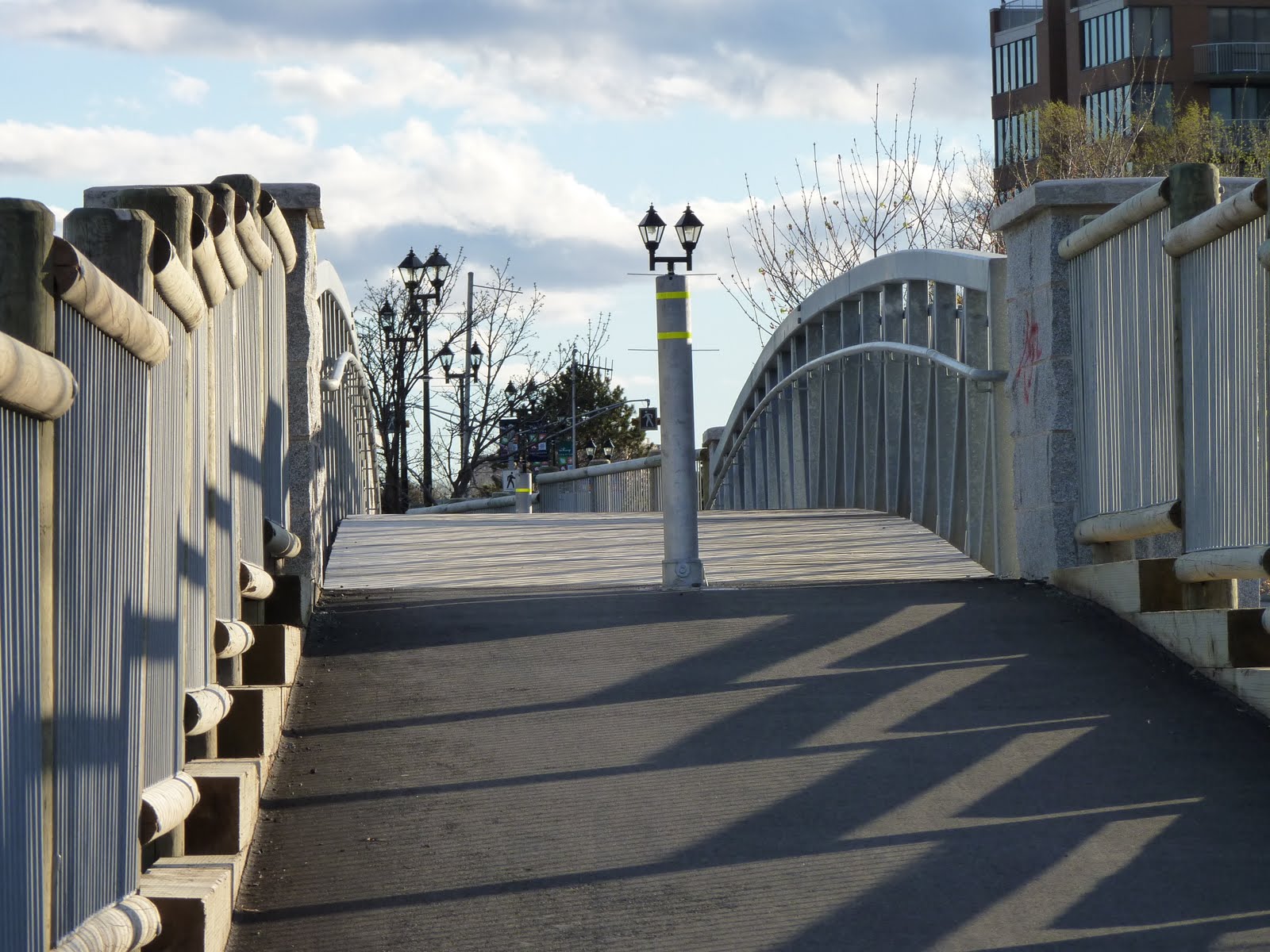
The walkway itself has been improved. It has a nice new surface in some places and a good place to cross the train tracks that also run along the watefront. We lingered on the bridge over the Schubenacadie Canal, and stopped to look at the paintings on the walls of some of the neighboring buildings. We found more art to than we had seen when we visited last year, including an official graffiti wall. The official walkway peters out, at least for a while, close to the graffiti wall. I took a little bit of exploring to find the next part, and we haven’t walked or biked that far yet - maybe next time we will.

Georges Island, through the branches of a tree

The official graffiti wall

The bridge over the Shubenacadie Canal

Rusty ship off the former Dartmouth Marine Slips


Pow-wow on the Commons - Membertou 400

In June we went to a pow-wow on the Halifax Commons, held to commemorate the 400th anniversary of the baptism of Chief Membertou of the Mi’kmaq nation and 20 of his family into the Christian faith - they were among the first aboriginals to become Christians. It seems to have been a strategic move, the basis for an alliance between the French and the Mi’kmaq nation that lasted 150 years. The pow-wow was interesting - there was a Mi’kmaq Cultural Village, a marketplace and free samples of a variety of aboriginal foods.

We walked to the Commons over Citadel Hill (good exercise!), and were greeted by the sight of tipis, the sound of music, and the activity created by lots of people, including lots of children, walking around, looking and listening. We spent time watching the grand entry parade, with flags and beautifully dressed dancers and drumming. Then we turned to the stage to watch and listen to Buffy Sainte-Marie. She and the band she was working with played and sang old favorites, powerful anthems and songs from her new album, Running for the Drum. It was a great show, the band she was working with responsive and enthusiastic, and after an encore they all left the stage singing.

If you enjoy her work, here’s a taste...


Purcell’s Cove Marina

The marina is where you’ll find us now, most weekend days. It’s our new weekend haunt, where we spend time on the boat repairing and strengthening parts of the deck, fabricating (so far) a new anchor locker, sanding and re-sanding lots of stuff, and discussing and figuring out what works and what needs changing. We have a much better idea now of how to set things up to work well for us underway.

Whoever is working outside can - at least until we put up a cover - look out over the marina and across the harbour. There we can see other boats sailing, racers passing by or jostling for a start, and container ships and other vessels coming and going. We saw the start of the race to St. Pierre, a race which included Spirit of Canada - and, we later found out, a boat which carried a friend from Ontario as crew. The sun has been shining, and we both have farmer’s tans - brown about the arms and face, and winter white elsewhere.

Looking out across the harbour...

Looking toward the hill behind the marina...


Our Refit

The boat has now been emptied of most things that can be taken off. We have begun some repairs on the deck, strengthening where the anchor windlass was and will be again. We have, filled in the hole where our chimney once was, taken out and filled in where the pumpout fitting used to be (we don’t need it with a composting head - and it was leaking). Holes in the wooden bulkheads, acquired over years of putting up hooks and fittings, have been carefully filled in. The bow has been well cleaned inside and we are part way through making the new anchor chain locker, which will sit low down in the hull. Generally, we are trying to work our way back from bow to stern. We divide the work up so that one of us is usually outside when the other is working inside...

We are thinking about setting up a separate blog to track our refit - if you’re interested in following along in more detail (complete with pictures and how-we’re-doing-it) please leave a comment or e-mail, and let us know!


Monday, March 15, 2010

Men Who Are Passionate About Oceans

One of the greatest pleasures of going to the Halifax International Boat show is the chance to meet and talk to people who are passionate about the oceans we travel, live and work on. This boat show there were two men whose dreams we want to share with you.

Derek Hatfield, solo ocean racer:

Derek Hatfield is now getting ready to set out on his next great adventure, the VELUX 5 Oceans single-handed round-the-world Race. And he sees his entry into this race as important not just because he will represent the many Canadians who support him but because he will also be doing something he believes in - taking an ecologically friendly approach to ocean racing.

He talked with great enthusiasm about having the chance to enter the race in the Eco 60 class, a class which transforms older Open 60s and gives them a new life as wind, solar and electric powered ocean race boats. This gives the racers sailing them the pleasure of racing in a way that is both less expensive and more ecologically friendly. Note - less expensive. It still costs a lot, and once again Derek is offering those who support his challenge the opportunity to travel round the world in spirit with him, with their name on his hull. And more to those who are able to contribute more.

As those who have had the chance to talk to him know, Derek is both a fine sailor and a gentleman, someone who never hesitates to share both his enthusiasm and his knowledge. He represents the best of Canada both in the water and in person. I hope you’ll be able to help support him - you can find all the information you need to learn more Derek, the race and the adventure here.

Captain Art Gaetan, the Sharkman, of Blue Shark Charters:

A great story teller, and passionate about sharks, Art Gaetan has built a substantial body of knowledge about these creatures, and managed to develop businesses that respect and teach others about the oceans, sharks, and their role in the ocean environment. And to have fun doing it.

Yes, he fishes for sharks, but every shark caught is tagged and released and every detail entered into a scientific database; every experience adds to the store of knowledge about their lives; and as we found out any experience may become the fodder for a great story.

His presentation was a mixture of facts, explanation and just plain great stories. The last story had us laughing so hard there were tears in our eyes. We are not fishers of sharks, but if you ever want to catch a shark, here's the man to help you do it.

Halifax Again, February 2010

February in Halifax was a little warmer than normal, so they said. Warm or not, it was still a time when the fronts come through one after the other. February is a month when you’re glad you have a warm place to live in, and that your boat is as secure as you can make it.

And the boat show. One of the highlights of February in Halifax, for us, is the Halifax International Boat Show. It’s a chance to look at gear, attend any talks we’re interested in, possibly run into a few people who are doing the same thing. This year we were pleased to find a Canadian East Coast distributor for the electric motor we are going to buy - and to see the actual engine, up close and personal. We had a chance to learn a bit more about the heating system we’re planning to put in (Webasto) and see the heater itself as well; checked out a radio that would keep our iPod dry and safe while at sea; learned about the superwind wind generator; checked out a small butane stove, just because it looked like a good idea (but still not as safe as our Origo). We heard from Derek Hatfield about the work he is doing to represent Canadians in his next solo ocean race, the VELUX 5 Oceans Race. We were entertained by and learned from Captain Art Gaetan, who talked about sharks, shark fishing, and how he turned his passionate support for sharks into a multi-focused business. We found the Windbag Company of Nova Scotia, which makes bags out of old sails and old seat belts and other reclaimed material, and, an extra touch, includes in each bag the story of the boat whose sail went into the making of it.

Then to remind us that we should not get complacent, on the last Friday in February a strong easterly blew through, bringing rain, a high surge on a high tide, and gusts up to 135 km/h on the bridges across the harbour. In Purcells Cove, where the boat is, the wind and the surge brought waves up over the shore and into the area where the boats were stored. The water softened the ground, and the combination of wind and soft ground caused three boats to blow over. Into The Blue stayed safe on her cradle, but one of the sailboats in front of us blew over when a stand dug in, and came to rest with its mast resting on the powerboat beside it. The big docks that normally mark the outer edge of the marina, the only docks that stay in during the winter, were almost all blown off their moorings, and some of them badly damaged. The overall conditions might have been less severe but, thanks to the wind direction and the surge, the damage at the marina was worse than the damage there in Hurricane Juan. Nature is a very powerful force.

Now it’s the beginning of March, and the ice is melting out of the small lakes. The water birds are enjoying the change, feeding happily in the water, and in the mornings we can hear other birds singing, see them in the trees, on the wires, on the roofs. The days are growing longer. The Spring brush fire season has started. Time for us to start working on the boat...

2009 Ends, 2010 Begins

November there was NaNoWriMo, the month of writing 50,000 words. December there was recovering from NaNoWriMo, and getting ready to travel to Toronto for Christmas then further south after.

Before we arrive, it always feels as if there will be lots of time to do everything we want to. After we arrive, we realize that the time we thought would stretch out blankly before us is actually already full of things to do. And this time it was also shorter than we had planned, as headed south early for family reasons.

These days I am thoroughly spoilt when we go on a road trip. I never renewed my driver’s license, thinking that I would not need for it (I forgot that even when not cruising plans are carved in jelly), so I have lots of time for watching the landscape as we pass through it. There is a lot of landscape on the drive from Halifax to Toronto. Happily it includes goodly amounts of beautiful landscapes, trees and hills lit by the sun, glimpses of water, stretches of city. In places you are reminded that nature is not always benign. There are the areas where trees charred by fire below sprout green above. Then there are other areas where landscapes roughly shorn of trees and plants remind us that our behaviour is not always benign either.

We paused overnight on the drive to Toronto on the outskirts of Quebec City. The room was warm, but when we woke in the morning it was achingly cold and the car was reluctant to start. A day later, in Toronto, we used their well thought out directions to find our way to the friends we were staying with. The days passed quickly, Christmas came and went. We saw more friends, but mostly we spent time with family. Then shortly after Christmas we set off to drive further south - earlier than we had planned, called by family business in Miami.

That journey too went well. We drove during the day and stopped overnight, and arrived there late and tired on New Year’s Eve. The next three days were relatively quiet - then we drove to Atlanta one day to take one of the family to catch a plane, stopped overnight with other family, and drove back the next. It helped a great deal to have a friendly place to lay our heads overnight in between drives!

January passed in and around Miami, taking care of business. The best that could be said about the weather there for several days was that it was warmer than Halifax or Toronto - we managed to get there in time for a record-breaking spell of cold weather. We walked many days; we enjoyed the brightness of the sun. Hearing news of storms in Nova Scotia, we followed the weather reports and paid attention to the direction of the wind, cheerful when the boat would be sheltered from the gusts and worrying when it would not. But all remained well there while we were away.

Our long drive back to Halifax was made much more pleasant because we visited with more friends along the way back. But we knew we were back in the land of snow and winter the fourth day along, when the snow no longer hid among the trees, where the shade lay, but glittered at us from the sides of the roads. When we pulled into the ploughed parking lot of a snowy rest stop that completed the confirmation.

Much of our driving was through hills and mountains, especially leaving the maritime provinces and on our route through New York and Massachusetts. Some of the scenery was breathtakingly beautiful, some of the drops awe-inspiringly precipitous. One morning we looked down on the fog rising out of a valley below, lit by sun above and shading the homes and fields and roads below.

We crossed back into Canada on the evening of our last day of driving, bent on getting back in time for Richard to have a day of rest before going back to work. That last day of driving was a long one, but we looked forward to being in our own place again. A day to readjust to life in Nova Scotia, and we edged back into our land-based routine again.

Some Pictures:

Thursday, January 28, 2010

Haiti - A Way for Sailors to Help

A quick note for all those who have not yet heard through other sources. OceansWatch North America and some of our cruising community are coming together to send help to Haiti as it tries to cope with the devastating earthquake and its aftermath.

OceansWatch is involved in helping put together a flotilla of vessels to carry needed aid to Haiti. All who can are invited to contribute, however they can. As news stories indicate, the need continues to be overwhelming, and every little bit anyone can contribute helps.

If you want to know more about their efforts, please go to their page describing what they are doing and how you can help.

You can find the information here.

Tuesday, November 10, 2009

Busy Times in October

October flew past in a flurry of activity. Richard went out to work, I worked at home (home for the present, anyway), blogging and writing and making arrangements and generally getting ready to go to Toronto for my art show. In between we finalized arrangements for taking Into The Blue out of the water at Purcell’s Cove Marina. We agreed on a nice sheltered spot, since she will be out for a while, and a friend offered us a cradle there we could use. Things began to fall into place.

Richard went to work on modifying the cradle so that it would fit Into The Blue. He cut, moved supports, and generally tried to make it ready. Then they moved the cradle into place, and that revealed a few weaknesses that meant trips to the lumber store, for 4 x 4s and 2 x 4s to reinforce areas that had grown rotten. After that, it was time to think about getting the boat from Alderney Marina across to Purcells Cove.

With my art show coming up rapidly, and the date for climbing aboard the train to Toronto even closer, we chose the best weather day we could find to move the boat. Winds had been blowing out of the north and the east, strongly. This day it was cold but, in spite of grey clouds building to the south west, the winds were good and the water pleasantly smooth. Richard fired up the outboard, thinking of a smooth trip across the harbour and around the shallows off Point Pleasant Park to Purcells Cove. We left it to warm up, while we got the sails ready - just in case. We always get the sails ready, just in case.

The outboard went one step beyond warming upn -it overheated. Then it refused to start. Time was passing. The clouds were building. The choices were diminishing. We pulled the sails up and went. The sailing was good. We went to Plan C - Richard called ahead to say we were on our way without an engine, and what were our options?

The wind was from a good direction for sailing down the channel into the cove and to the marina. It seemed our option - the one we ended up using anyway - was to sail in to the dock, where someone would meet us and take our lines. The only snag there was when the main decided to jam and not come running smoothly down. We kissed the tyres on the outside docks and everyone stayed well clear of the boom as they took our ropes. Then they held us long enough for us to get the main lowered, handed us down to an empty slip and left us to tidy up and take down and put away our sails. With that accomplished I left Richard to finish haul-out preprations while I prepared for the show.

During that week he took the mast down, worked more on the cradle, and generally go the boat ready to be hauled. Then, while I concentrated on last minute preparations in Toronto, the boat was hauled in Halifax. By crane. Those who have boats will know the feeling of seeing your boat lift from the water hanging on two straps over water and then over rocky land... Richard got to witness the lift directly - I only had to look at the pictures afterward.

Putting the boat on the cradle revealed a few more spots in need of reinforcement, plus some slight miscalculations. More lumber, more cutting, more shoring up - but now as you read this Into The Blue is sitting on her cradle, waiting for us to erect a shed around her to protect us and boat from the worst of the weather. Meanwhile we’ve started doing more unloading of gear and bits. It’s still amazes us what we can fit into a thirty foot boat.

For me, the time in Toronto was a welcome interlude, a chance not just to present my art and ideas but a chance to see some family and friends, and share what I had been doing. The time was almost all spent preparing for my art show. There was a lot of walking, meeting - and finding refuge in a friends apartment, where I could do all the writing and printing and computer checking that needed to be done. As for the show - you can read more about it on my art blog. Here I’ll just say it was exciting, tiring, and rewarding and that I’ll be doing another one next year, with a whole new group of paintings and prints.

In the meantime prints from this show are available online now, at an online store I’ve created, and as with paintings and prints sold at the show part of the proceeds go to support artists working with teachers and children to improve access to and the quality of education in one of the poorer areas of Nicaragua. Some of you already know a lot about the show and how it went, and I would invite anyone else who’s interested to visit my art blog and store site.

So now the boat is resting on it’s much strengthened cradle; I am back and recovering from the burst of activity in Toronto. And the winds and weather of a Nova Scotia fall are coming and going, sometimes tempestuous, sometimes calm. We are looking ahead to weekend days of planning and measuring and remeasuring and discussing and boat work. On and off the boat.

Refit time...

Haulout pictures courtesy of Swedish Joe, who had his camera there.


Friday, October 09, 2009

September Wanderings

The leaves are turning, and the temperature is getting colder. There has been a little time for exploring, but mostly we’ve been working, each of us in our own way. Richard did have to take a little time off after being injured (he’s recovered, pretty well), and that was a challenge. On the other hand, we have settled on a place to keep Into The Blue during her refit, thanks to friends in Alderney Marina, and expect to take the boat over to Purcells Cove in the next week or so. It will have to be in the next week or so, since I (Margaret) will be leaving soon for Toronto, and my much-looked-forward to get-together cum art show cum fundraiser and the haul-out date will be before I get back. Betwen haul-out (by crane) and event the weekend of October 24th/25th will likely be a somewhat nervous time.

We have taken a little time out to explore. We found interesting public art while walking along the Dartmouth waterfront. We dropped in on a car show that offered rides in old British cars (the proceeds went to charity) and swapped a few tales with a British Leyland Mini owner. One sunday we spent a little time talking to a very friendly group of model sailboat racers by one of the lakes in the middle of town. One even gave Richard the chance to sail in one of the races. It may not be the same as sailing our own boat, but he had fun. Something to do while the boat is being refit? All work and no play...

There are no pictures from the time spent with the model sailboat racers, but here are a few of the pictures we did take.

Friday, September 11, 2009

Halifax, Summer 2009

After a warm, mainly sunny August the winds in Halifax have turned cooler again. Summer seems to have flown past. We’ve done a little sailing. We’ve gone to the Jazz Festival, and visited the tall ships on the waterfront. We’ve explored a little further on land than we could before - visited more of Dartmouth’s lakes, seen parts of St. Margaret’s Bay from the land side, instead of the water. We’ve found a very good Jamaican restaurant (Caribbean Twist - very good spicy hot jerk for those who like it, a range of curries and vegetarian dishes). We spent an enjoyable couple of weeks housesitting.

In the meantime we’ve been trying to make up our minds where to haul Into The Blue for the major refit that will take place over this winter and next summer - and hopefully not too much longer. And working hard at non-boat things. And planning and dreaming...

And of course we’ve taken some pictures - hope that you enjoy them.

Friday, June 05, 2009

A Little Bit of Shelburne, Nova Scotia

The red building is the Shelburne Harbour Yacht Club (and the Osprey Arts Centre); the building next to it houses the area where the longboat we saw was being constructed.


We treated ourselves to a good meal at the Sea Dog Saloon - lots of food, nicely cooked! And it offers dock-and-dine facilities - just bring your dinghy to the dock - and free wi-fi so we could let people know where we were.


Sailboats were anchored off the waterfront, one from the Netherlands and another we guessed might have been British - both looked well-traveled.


As you look out you can see why the harbour is well-sheltered.

Back to Halifax, via Shelburne, Nova Scotia

The seal that had watched us leave Martha’s Vineyard set the tone for our travels to and along Nova Scotia. Winds remained generally light, which gave us lots of time to see some of the creatures that shared the waters with us - and on this part of our journey we saw more in a couple of days than we had seen during all the days of our earlier travels. Between Martha’s Vineyard and Shelburne a large right whale came to the surface off our stern, lay at the surface, blew a couple of times, cast a beady eye our way, and opened his mouth before disappearing under the water. We next saw its spout off in the distance. The next day a pod of what looked like orcas appeared off our port side. Later, we saw the back and fin of what was probably a minke whale.

Dolphins came past the boat several times, mostly just cruising by but occasionally pausing to hunt around the boat. We saw many birds traveling, feeding or resting - black-headed laughing gulls, ring-billed gulls, storm petrels paddling their feet on the water as they fed, terns and others we have not yet identified. Every creature seemed to be on the move...

Between Shelburne and Halifax we saw more whales. At one point we found ourselves sailing where, temporarily, food was plentiful: birds circled overhead, dolphins hunted and a minke whale surfaced and disappeared ahead of and beside us. When creatures are feeding, they are so concentrated on getting food that where they are is not the best place to be, however interesting; we were glad to move away from them. In the still, windless hours of one very dark night we heard the breathing of and the sound of water lapping around what must have been a sleeping whale off our starboard side.

We always leave our depth sounder on, on the theory that its ping lets dolphins and whales know that we are there. Sources suggest running your engine at low rpm as well, but of course we had no engine to run. Still, it was very unlikely that any of them would deliberately pose a threat to us, and since we were proceeding slowly we were not exactly a threat to the creatures around us. Though, some of them being rather large, there was no doubt that we would prefer to avoid getting too close to them.

Since light wind dominated most days, our actual sailing consisted mostly of making every effort to keep the boat moving. Hour by hour we crept along, enjoying gusts and short periods of good winds when they came and hand-steering much of the time in between. Or, when steering was not really possible, at least trying to keep the boat pointing in the right direction. After the engine had swallowed sea water as we left Pollock Rip Channel we could not resort to using it even when the seas were almost flat. Nor did we want to risk fixing it at sea, since Richard needed to take the carburettor apart to dry it out, and any part that fell out there would likely be lost forever. We would be sailing in to our next harbour, but if our next harbour was Halifax that would not be a problem.

As we approached Nova Scotia another blow was threatening, with possible gale force winds. We were a day and a half of good sailing from Halifax, and the sailing was slow - so it could take much longer. Under the circumstances we decided to go in to Shelburne, somewhat nervous because we had no detailed charts of the harbour itself. Not that we planned to go in totally blind; we knew there was a yacht club in the harbour, and we had its phone number. We hoped to get at least some of the information we needed from them. As we approached we tried to radio, then phone the Shelburne Yacht Club. What we did not know was that it was not fully operational yet and not open every day. When we did manage to contact the club later in the morning we tried to find out about coming in; the young lady there did her best to be helpful, but she was clearly not a sailor.

However the fates were kind to us. As we came closer we saw a motor vessel off the shore, going in, so we radioed them and told them about our dilemma. The boat was Ohana; this was their first time here as well, but they were well equipped with a chart of the harbour on their chart plotter. They kindly agreed to keep an eye out and let us know what we needed to know to come in safely. We were lucky that there were two sailors on board, including the man on the radio, and they understood what we needed to know. They gave us good information, letting us know what buoys lay ahead and where we could expect to see them, and stayed in touch with us until we picked up a mooring ball off the yacht club. When we were in and had taken care of our immediate needs we went to find and thank them.

First order of business, and first phone call: checking in with Canada Border Services. Since we could not come to a dock, they came to us, courtesy of a boat from the Sea Dog Saloon. Then it was time to let family and friends know where we were, tidy up the boat, try to make ourselves look respectable, and go ashore. The Sea Dog Saloon offers dock and dine; we took the dinghy in to their dock and enjoyed a good and hearty meal while taking advantage of their free wi-fi (passworded). Then to the yacht club to check what facilities were available and pay for our mooring. the cost was very reasonable, at $15 a night with a weekly fee if we needed it, and there were showers for $2. Cruising sailors will be happy to know that they make their facilities available to anchored boats, for a daily or weekly fee, and there is laundry (extra cost) as well as showers. Since we paused for two nights, we also found out that Friday night was a busy, social night, with food and drink and lots of conversation.

We did not spend much time in Shelburne, but it was enough to be aware of the many historic buildings along the waterfront, and to be invited in to see a longboat, being built and well along the way to completion. We will probably see it sailing, since it will be visiting Halifax for the 250th anniversary of the Royal Navy Dockyard in mid-July. On our walk to the grocery store we found people in the town friendly, helpful and welcoming and quick to give directions and point out things we might find interesting. When we come back we’ll be able to visit some of the museums we walked past, and the waterfront art gallery and theatre, maybe even enjoy one of the living history re-enactments Shelburne is known for.

Apart from discovering a good harbour and pleasant place to visit, stopping gave us time to take apart and dry out the motor on the deck instead of over the water. Then we used it to leave again, motoring out of the shelter of Shelburne Harbour early on our second morning in light winds, past fish farms and fishing boats and fish and boat related businesses scattered along the coast. We had two long days of light winds as we moved toward Halifax. On our last day out, we had south west winds and fog, so we ended up approaching and entering Halifax Harbour in the fog and the dark, using radar and frequent chart positions to take us safely in. As we approached we checked in with Halifax Harbour Traffic, and kept a listening watch as they directed so that we could hear the movements of ships and a coast guard vessel as they went through the harbour and stay out of their way.

Once past McNab’s and George’s Islands we found ourselves tacking past oil rigs moored in the harbour. It was after midnight, and by now we were out of the fog, and grateful for the ambient light that made it easier to find Alderney Marina and pick up a mooring ball there. We were finally back in Halifax. As soon as we were secure we has something to eat (food had not been high on the agenda as we worked our way through the fog) before we fit in a few hours sleep. It seemed very little time had passed before we were waking up to start making phone calls and begin the process of picking up the threads of work and life on shore.

Now we are back, and it is time to decide on where, when and how to haul out and refit Into The Blue. Hopefully we’ll fit a little more sailing in before she joins us on dry land. We'll let you know.

Thursday, June 04, 2009

Martha's Vineyard, Spring 09

The ferry to Woods Hole, leaving past the moorings off Owen Park in Vineyard Haven.


This graceful stone building is the Bank of Martha's Vineyard, originally a harness and saddle shop.


The Stone Church, home to the Christ United Methodist Church, built in 1923.


Spring trees on the Vineyard.


Trees, a stone wall, a small building - some of the things we quite often saw as we walked around.

Chesapeake to Martha's Vineyard

The trip from Chesapeake to Martha’s Vineyard started very nicely, with a good sail out of the Bay on a nice combination of wind and tide. After that things changed rather quickly - from sun and wind behind to fog and wind on the nose. Our first day out we traveled 80 miles through the water to get 42 miles closer to where we were going; our second day out was a little better. Then the wind went from light to gale force, and we sat out three hours of heavy weather hove to before we started sailing again. After that we had about twenty-four hours to get to an anchorage before the next big blow. We set our bow for Martha’s Vineyard, and coaxed as much speed as we could out of the boat while the winds were light, sailing through a foggy night.

The next morning found us approaching Martha’s Vineyard in rising wind, enough to carry us through the current if we stayed relatively close to shore. And we managed to talk to one of our friends there, Dennis, by phone, and he offered to see us into the shelter of Lake Tashmoo and let us use his mooring there, since his boat was on the hard. We were flying along (for us) going in and out of the fog, watching our lat/longs and charting them frequently to make sure we stayed in good water, when we came around the last point before the entrance to Lake Tashmoo and saw the lights of his truck beckoning us in.

He helped us through the entrance, signaling where the water was deepest. We came safely through the entrance, aimed for the red buoy we had been told to hug - and ran aground on the sandbank beside the channel. We put up all available sail to try and sail ourselves off, tilted the boat well over - and stayed stuck. Richard started to put our dinghy together, to take an anchor out into the channel. He was about halfway through when a small sailboat motored briskly away from a dock and towards us, and one of the young men on board offered to row our anchor out into the channel so we could try and winch ourselves off. We were in the middle of doing that when Dennis called to say he was on his way with a fisherman, to help us off. The cavalry was coming.

Things got a little confusing for a short while, for two tired people who were really looking forward to being able to rest. But Dennis and his fisherman friend rapidly sorted us out, and before we knew it we were on our way down the Lake and then securely tied to Dennis’ mooring. And then they wished us a good rest, and left us appreciating how well a difficult sail can end with just a bit of willing help.

We tidied up the boat (your boat takes care of you, you take care of it), made sure things were secure for the coming blow, finished putting the dinghy together and fell into bed, leaving other considerations for the next morning. Late the next morning, which was when we woke up. Communications were the first order of business, so we walked in to town to a cafe where we could use the internet, then met Dennis and went with him to enjoy an afternoon of hospitality and help.

We started the next week with a ride from the kind fisherman who had hauled us off the shoal. He took us most of the way to a welder who would fix our outboard bracket for us - it was showing signs of rust and wear. Whit Hanschka at Fine Metalwork took time from creating much more elegant pieces to help us. That took care of one necessary task - we walked in to Vineyard Haven that day and several others to take care of the rest of the things we needed to do. We wanted to make sure we had provisions on board and would be ready to go when we could, even as we enjoyed the shelter and beauty of Lake Tashmoo.

It was almost a week before a break in the weather seemed imminent. Since we needed to leave Lake Tashmoo on the right tide and the tide we would need to help us across the Sounds and through the Pollock Rip Channel would run at a different time, we dropped Dennis’ mooring the day before our possible departure and made our way to Vineyard Haven. We anchored outside the breakwater for the night and the next day we ran errands and did laundry while we waited to find out our chances of leaving. When we found out the next day that there would be one more blow to sit through we moved on to a mooring ball in the harbor, a much better place to be when winds blow out of the north. Picking up the mooring in windy weather using the outboard proved a bit of an adventure, but we finally got settled, ran our last errands, stowed the dinghy on board and got ready to leave the next day, after the weather had settled down again.

We left a little later than we should have the next morning. That may be why we did not quite make it through the Pollock Rip Channel, even after a good sail with fair winds and good current across the sound. Or it may be because the wind dropped before we could get through; or because a wave detached the gas line from the motor as we were using it to try to get past those last two channel markers. Without wind or engine we did what many sailboats have done before us - dropped an anchor, and waited for the wind and current to change. It took five hours - enough time to enjoy supper, clean up, have a chat and a rest. Then the current slacked off and the wind came up just enough for Richard to coax Into The Blue past those last two markers, and we were on our way to Nova Scotia.

A curious seal had watched our progress through the channel, popping up at odd times in different spots. We last saw it as we turned toward Nova Scotia.

Wednesday, June 03, 2009

Old Point Comfort and Hampton, VA

The elegant Chamberlin Hotel, once a place for the rich and famous to visit and now re-created as an upscale retirement community.


A scene from the family life of soldiers at Fort Monroe recreated in the Casemate Museum.


Good advice? For some, anyway.


Hampton University buildings, on one side of the anchorage.


The Cousteau Society Museum, and the Crowne Plaza Hotel, on the other side of the anchorage.


Fishing boats docked off the fish plant share the shelter of Hampton with cruising, tour and local pleasure boats.

Visiting Old Point Comfort and Hampton, VA

After a couple of days of pleasant, warm sailing, the good weather window we were enjoying threatened to close. Our choices for places to shelter this time: Chesapeake Bay or Cape May. We chose Chesapeake Bay - for one thing it was the perfect opportunity to meet one of the voices we had been talking to on the Cruiseheimers Net in the mornings, for another it was that much closer to where we were - and that much further away from where the actual bad weather would occur, further up the coast.

So we consulted our charts and chose our course to an anchorage in Old Point Comfort. We were close to the bay’s entrance when the wind dropped, leaving us trying to coax the boat to get closer while the tide and current were still favorable. Finally we had to admit it was either take many more hours that we wanted to to get there, or turn once again to our trusty motor. So we started our motor and travelled slowly into and up the bay, keeping an eye out for ships and barges as we went and for any large power boats creating large wakes that might swamp the engine (Not every large powerboat is so thoughtlessly driven - so this is a good time to thank those skippers who are considerate and knowledgeable enough to pass smaller boats and sailboats gently). In the end it was the powerboat wakes that were the greatest problem, and at one point we were not sure that our engine had survived one of its dunkings. But it started again and kept on going, taking us in to anchor outside the channel across from the Old Point Comfort Marina.

Old Point Comfort is home to Fort Monroe, the third oldest continuously operating military installation in the United States and site of the largest stone fort in the U.S. Visiting is an interesting experience. The marina is for military and Depart of Defense personnel, but the boat ramp, fuel dock and restaurant, as well as the Fort and the surrounding area are open to the public (anyone wanting to enter by road must show photo identification). Being anchored there gave us a good opportunity to visit the fort and its Casemate Museum, and we walked past the elegant Chamberlin Hotel, now reborn as an independent living apartment community, along the seawall and along quiet streets with nicely maintained historic buildings. We enjoyed the Casemate Museum, which presents the history of the fort using a nice variety of exhibits, and were lucky enough to hear part of the presentation to a tour of military personnel. There’s always something interesting to be learned from a knowledgeable guide.

We enjoyed visiting with our friends, who helped us get around and find what we needed. Then they were off to do other things and the wind and weather were changing. We decided to move to more sheltered anchorage in Hampton, across from the Hampton Public Piers, between Hampton University and downtown. The last time we had been there it was crowded - it was far from crowded when we arrived, though the anchorage did start to fill up the next day. We found ourselves a good spot just outside the channel, and settled in for a few days.

A trip ashore showed us that things were much as they had been last time we were here. Free wi-fi on the docks, access to washrooms (free) and showers (payment required), and friendly helpful staff. Happily we had been to the grocery store with one of our friends - there are only convenience stores close by. The laundromat was a brisk walk away, across the bridge by the anchorage; we shared it with several Hampton University students, who helped us figure out the oddities of some of the machines. There was not enough time to linger around the art galleries or re-visit the Cousteau Museum - or to visit the Virginia Air and Space Center, or explore further. So yet again - we want to go back when we have more time. And before we go we’ll download the iPod tours the city has developed, which are an interesting concept and well-suited to the kind of exploring we like to do.

Laundry and grocery done, we were ready when Herb of Southbound II said there might be another weather window. Early in the morning on our third day we started the engine, picked up the anchor, and set off out into the bay, heading seaward again.

Tuesday, June 02, 2009

April in Beaufort, NC

Large motor yachts were heading north, stopping at the Beaufort Town Docks on the way.


Spring brings a lushness to the trees and plants along the roads.


Spring flowers...


The Beaufort dinghy dock where we tied our dinghy up to go to shore, and a little beach where small boats are beached and launched.


Looking out from the boat over the anchorage at sunset.


For those who are interested: Our trusty little engine on its bracket. You can see where the bracket that allows the engine move up and down is attached to the deck behind the cockpit; the tube coming forward from the bracket helps to keep the engine in place when it is running.